
Every Foundation Crack Tells a Story — Reading It Correctly Saves Thousands
Not every crack in a concrete foundation is a structural emergency. And not every "cosmetic" crack is harmless. The difference between a $150 injection repair and a $50,000 foundation replacement often comes down to a 20-minute assessment that most homeowners and even many contractors skip.
As a manufacturer of epoxy injection resins and structural reinforcement systems used in thousands of foundation repairs worldwide, we see the full spectrum — from panic over hairline shrinkage cracks to dangerous neglect of active structural failures. This guide teaches the assessment process our engineering team uses when advising on foundation repair material selection.
Step 1: Classify the Crack Type
The first step is identifying the crack pattern, which reveals the cause:
Vertical Cracks (Most Common, Usually Least Serious)
Vertical cracks running straight up a foundation wall are typically caused by concrete shrinkage during the initial curing period. Concrete shrinks approximately 0.04 to 0.06% as excess water evaporates — on a 10-meter wall, this equals 4 to 6 mm of total shrinkage, which concentrates at weak points (window corners, pipe penetrations, wall mid-span) as visible cracks.
Assessment: If the crack is less than 0.5 mm wide, does not widen over time, and both sides of the crack are flush (no offset), it is almost certainly a shrinkage crack. Repair with low-viscosity epoxy injection resin (100 to 300 mPa·s) for structural restoration, or polyurethane injection for waterproofing only.Horizontal Cracks (Always Investigate)
Horizontal cracks on foundation walls indicate lateral pressure from soil, hydrostatic water, or frost heave pushing inward on the wall. These are more serious because the failure mechanism is structural — the wall is bending beyond its design capacity.
Assessment: Measure any inward displacement of the wall above the crack. Displacement under 5 mm with a stable crack (not widening): repair with epoxy injection followed by carbon fiber reinforcement strips bonded vertically across the crack to resist further bowing. Displacement over 10 mm or a widening crack: consult a structural engineer before any repair.Diagonal (Stair-Step) Cracks
Diagonal cracks (or stair-step cracks in block/masonry foundations) indicate differential settlement — one part of the foundation is sinking faster than another. The crack follows the mortar joints in masonry or runs diagonally across poured concrete.
Assessment: The wider end of a diagonal crack points toward the settling side. If settlement has stabilized (crack width unchanged over 6 months of monitoring), repair with epoxy injection and optional CFRP reinforcement. If settlement is ongoing, the cause must be addressed (soil stabilization, underpinning, drainage improvement) before crack repair.Pattern (Map) Cracking
A network of shallow, random cracks across a large area of the foundation surface. Caused by drying shrinkage of the surface layer (plastic shrinkage cracking) or alkali-silica reaction (ASR) — a chemical expansion within the concrete.
Assessment: If cracks are less than 0.3 mm deep and do not extend through the wall thickness, they are surface defects. Repair with a polymer-modified repair mortar coat. If cracks are through-thickness with gel exudation (whitish deposits), ASR may be present — contact a concrete petrographer for analysis before repair.Step 2: Measure Crack Width and Movement
Crack width determines both the seriousness and the repair method:
| Crack Width | Classification | Repair Urgency | Recommended Method |
|---|---|---|---|
| < 0.1 mm | Hairline | Low (cosmetic) | Surface seal or monitoring |
| 0.1 to 0.3 mm | Fine | Moderate | Low-viscosity epoxy injection (100–300 mPa·s) |
| 0.3 to 1.0 mm | Medium | High | Epoxy injection (300–1,500 mPa·s) + waterproofing |
| 1.0 to 3.0 mm | Wide | Urgent | Medium-viscosity epoxy injection + CFRP reinforcement |
| > 3.0 mm | Severe | Critical | Structural engineer assessment required |
Step 3: The Resin Injection Decision
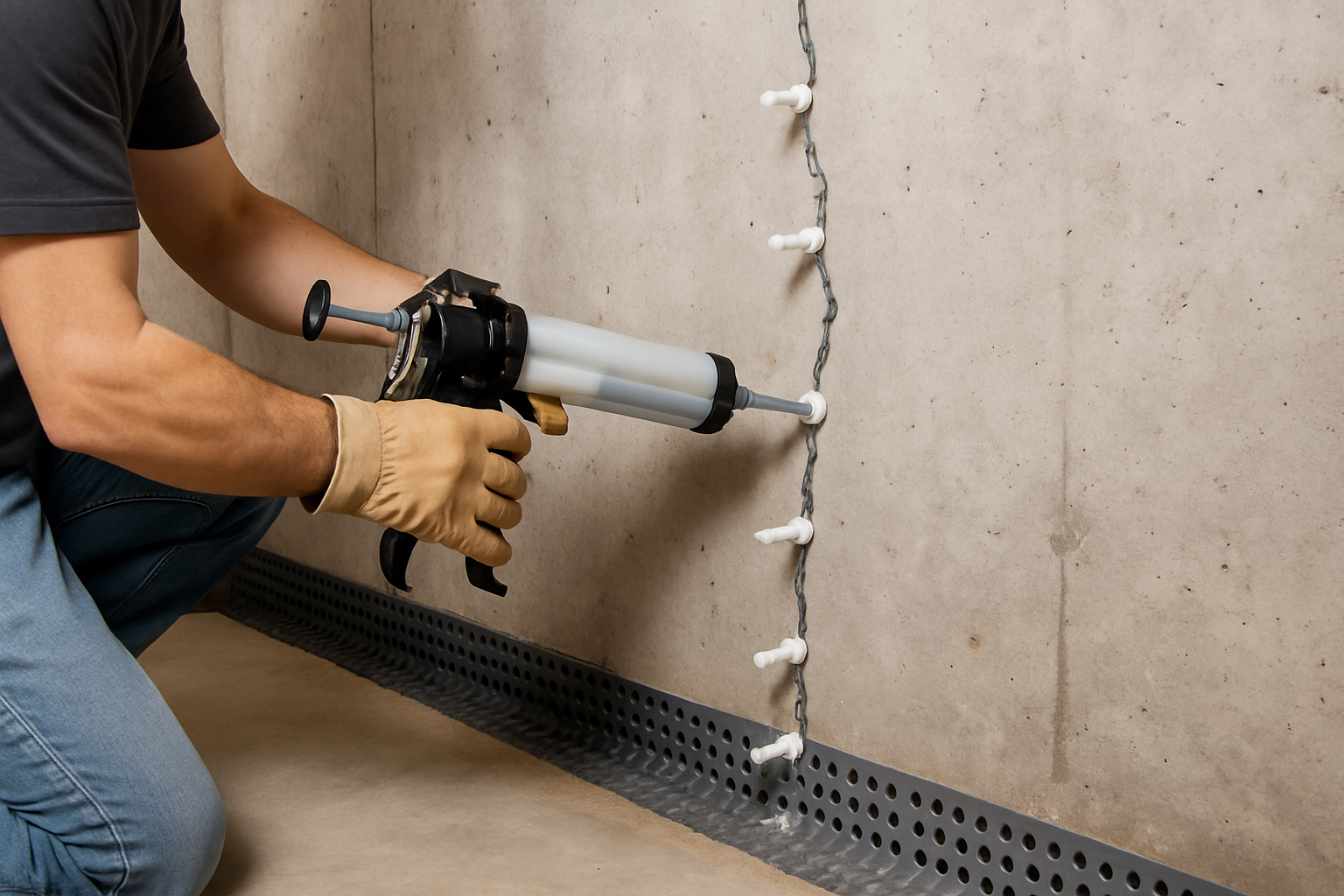
Resin injection for concrete foundations is the most cost-effective repair for cracks between 0.1 mm and 5.0 mm. The injected resin fills the full depth of the crack, bonding the two faces and restoring structural continuity.
When Epoxy Resin Injection Is the Right Choice
Epoxy resin injection for foundations is specified when:
- The crack is dormant (no longer moving, cause has been addressed)
- Structural restoration is required (the repair must carry tensile loads)
- The crack is in a dry or dried condition (standard epoxy requires no water)
- Crack width is 0.1 to 5.0 mm
When Polyurethane Injection Is Better
Polyurethane injection is preferred when:
- Active water leakage is present (polyurethane cures on contact with water)
- The crack is still moving (polyurethane is flexible, accommodating ongoing movement)
- Waterproofing is the primary objective (not structural restoration)
- Fast cure is needed (polyurethane cures in 1 to 4 hours vs 24 to 72 hours for epoxy)
When Injection Alone Is Not Enough
For foundation walls with:
- Horizontal cracks and inward bowing (> 5 mm displacement)
- Multiple parallel cracks indicating wall distress
- Crack widths exceeding 3 mm with rebar corrosion
Step 4: Prevention — Why Foundations Crack and How to Stop It
Understanding the cause prevents recurrence after repair:
| Cause | Mechanism | Prevention | Repair Approach |
|---|---|---|---|
| Drying shrinkage | Water evaporation during initial cure | Proper curing (7 days moist cure) | Epoxy injection (dormant crack) |
| Thermal cycling | Expansion/contraction from temperature changes | Insulation, control joints | Flexible polyurethane |
| Settlement | Uneven soil bearing, poor compaction | Soil investigation, proper compaction | Address cause first, then inject |
| Hydrostatic pressure | Water table above foundation level | Drainage, waterproofing membrane | PU injection + drainage |
| Overloading | Loads exceeding design capacity | Structural engineering review | Injection + CFRP reinforcement |
| Freeze-thaw | Ice expansion in saturated concrete | Air-entrained concrete, drainage | Repair + prevent water entry |
| Corrosion | Rebar expansion from rust | Adequate cover, cathodic protection | Injection + corrosion treatment |
Cost Comparison: Foundation Crack Repair Methods
| Method | Material Cost per Crack | Labor Cost | Total per Crack | Pros | Cons |
|---|---|---|---|---|---|
| Epoxy injection | $30–120 | $60–180 | $90–300 | Structural restoration, interior access | Requires dry conditions, 24h cure |
| PU injection | $20–80 | $50–150 | $70–230 | Fast cure, works with water | No structural restoration |
| Exterior excavation + membrane | $0 material | $1,500–5,000 | $1,500–5,000 | Addresses water from outside | Destructive, expensive, landscaping damage |
| Carbon fiber + injection | $80–200 | $150–300 | $230–500 | Structural + reinforcement | Skilled installer required |
| Foundation replacement | N/A | $20,000–50,000+ | $20,000–50,000+ | Complete solution | Last resort only |
Resin injection is typically 80 to 90% cheaper than exterior methods for the same crack, with faster completion (same-day vs 3 to 5 days for excavation).
Related Guides
- Resin Injection for Concrete Foundations: Epoxy vs Polyurethane — Detailed injection procedure with 8-step process and pressure data.
- Resin Injection for Foundation Repair: Lab Data — Viscosity-to-crack-width penetration table from our laboratory testing.
- Crack Injection Resin: Low vs Medium Viscosity — Selecting the right viscosity grade for your crack width.
- Concrete Foundation Repair Methods & Materials — Broader overview of foundation repair techniques beyond injection.
- Carbon Fiber Beam Strengthening — CFRP reinforcement techniques applicable to foundation walls.
- Two-Part Epoxy Adhesive Guide — Understanding the epoxy chemistry behind injection resins.
- Cementitious Grout vs Epoxy Grout — Grouting after crack repair to fill voids and stabilize the foundation.
- View All XINCHOR Crack Repair Products — Low-viscosity and medium-viscosity epoxy injection resins.
Frequently Asked Questions
How do I know if a foundation crack is structural or cosmetic?
A structural crack affects the load-carrying capacity of the foundation. Key indicators: the crack is wider than 1.0 mm, it runs horizontally or diagonally across the wall, the two sides of the crack are offset (one side is higher or deeper than the other), or the crack is actively widening. A cosmetic crack is typically vertical, less than 0.3 mm wide, with no offset, and stable over time. When in doubt, monitor the crack for 3 to 6 months — any widening or displacement indicates structural involvement.
Can I inject a foundation crack myself, or do I need a professional?
Surface-mounted epoxy injection of simple vertical cracks (under 1.0 mm, non-structural) can be done by a competent DIY person using a cartridge injection system. However, structural cracks, horizontal cracks, active water leaks, and cracks wider than 1.0 mm should be repaired by a certified injection specialist. Incorrect injection can make the problem worse — for example, injecting with too much pressure can hydraulically fracture the concrete around the crack.
Is epoxy injection a permanent repair for foundation cracks?
Yes, if the crack is dormant (no longer moving). Cured epoxy has a tensile strength of 30 to 50 MPa — significantly higher than concrete's tensile strength (2 to 4 MPa). The repair is permanent because the epoxy bond is stronger than the original concrete. However, if the crack cause is not addressed (e.g., ongoing settlement, hydrostatic pressure), new cracks may form adjacent to the repaired crack. Always address the cause before or concurrently with the repair.
What causes foundation cracks to appear years after construction?
The most common delayed causes are: soil settlement (clay soils shrink during drought and swell during wet periods, cyclically loading the foundation), tree root growth extracting moisture and causing differential settlement, changes in drainage patterns directing water toward the foundation, and long-term creep and relaxation of the concrete under sustained load. In seismic areas, even minor earthquakes (M3 to M4) can cause hairline cracks that widen over subsequent years.
How much does foundation crack assessment cost?
Professional structural assessment of foundation cracks typically costs $300 to $800 for a residential property, including visual inspection, crack mapping, and a written report with repair recommendations. This cost is well justified given that it determines whether the repair costs $200 (injection) or $50,000 (replacement). Some injection contractors include free assessment as part of their repair proposal.