
*Last Updated: 2026-10-12*
> Quick answer: For mining equipment with dynamic or impact loads (SAG and ball mill soleplates, jaw, cone and gyratory crushers, vibrating screens, slurry pumps), specify an aggregate-filled epoxy machinery grout with 70+ MPa compressive strength, ≥ 95% effective bearing area and resistance to gear oil. Cementitious non-shrink grout (60–80 MPa) remains the economical choice for conveyor drives, static structures and column base plates. The deciding factor on an operating mine is usually not strength. It is downtime: epoxy grout carries load after about 24 hours at 20–25 °C, while cementitious grout needs 3–7 days.
Key takeaways- Mining machinery grout fails at corners, edges and oil-soaked zones far more often than in the middle of the pour. Edge geometry and oil resistance matter more than headline strength.
- On a SAG mill, every hour of shutdown is expensive. That is why epoxy usually wins on total cost, even at roughly 5–8× the material price per litre.
- Plan a regrout in one shutdown window. Allow about 24 hours of epoxy cure at 20 °C or more, and add heating time on cold, high-altitude sites.
- XINCHOR supplies epoxy grout at USD 3.20–5.60/kg FOB Ningbo (MOQ 500 kg, 12–18 days) and cementitious grout at USD 0.35–0.70/kg (MOQ 1,000 kg).
Why Mining Equipment Foundations Are Harder to Grout
Most grouting guides are written for pumps and compressors in a refinery: smooth rotating loads, a heated building, and a planned turnaround. A concentrator plant is a much rougher environment for the grout layer under a baseplate:
- Impact and cyclic loads. A jaw crusher's swing jaw reverses direction hundreds of times per minute. Cone and gyratory crushers transmit eccentric loads that change with feed size. Vibrating screens are designed to shake.
- Very large, very heavy bases. Grinding mill soleplates under the main bearings carry the mill shell, liners and charge. The grout layer must stay flat enough to keep the ring gear and pinion in alignment.
- Oil, slurry and water. Gear lubricant, hydraulic oil and process water reach the grout edge on almost every site. Cementitious grout is porous and absorbs oil. Over years the oil weakens the paste near the edges.
- Remote and extreme sites. High-altitude Andean plants, Australian summers, and sub-zero winters in Mongolia or Canada all push grout outside the 10–30 °C window that most manufacturers recommend for storage and placement.
- Short shutdown windows. A regrout has to fit into a planned shutdown. A grout that needs a week before the machine can restart is often simply not an option.
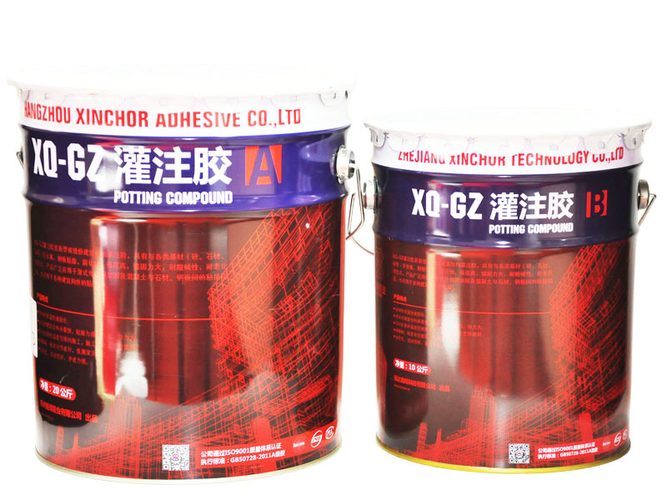 *Two-component epoxy grouting compound supplied in matched A/B kits. Mix full kits only, because the ratio controls the cured properties.*
Grout Selection by Mining Machine
The table below is the starting point we give mining contractors when they send us a bill of quantities. Always check the equipment OEM's installation manual first, because some OEMs name a grout type or a minimum strength.
| Equipment | Load type | Recommended grout | Why |
|---|---|---|---|
| SAG / AG mill soleplates | Very heavy static + cyclic | Aggregate-filled epoxy | Holds gear/pinion alignment, resists lube oil, short cure |
| Ball mill soleplates | Heavy static + cyclic | Aggregate-filled epoxy | Same as SAG; often regrouted together |
| Jaw crusher base | Impact, reversing | Epoxy | High tensile and bond strength resist edge cracking |
| Cone / gyratory crusher base | Eccentric, impact | Epoxy | Same reason. Liner backing compound is a different product |
| Vibrating screens & feeders | High-frequency vibration | Epoxy | Better fatigue and damping than cementitious grout |
| Slurry pump bases | Rotating, wet | Epoxy (API 686 practice) | See our pump skid grouting guide |
| Conveyor drive & pulley bases | Moderate, steady | Cementitious non-shrink | Economical. Loads are well within its range |
| Structural columns, stacker rails | Static | Cementitious non-shrink | Large volumes, low cost |
Note one common confusion. Crusher liner backing compound is the epoxy poured behind the manganese liners inside the crusher. It is not the same as the foundation grout under the crusher base. Order the two separately.
For a detailed property comparison, see cementitious grout vs epoxy grout.
The Standards That Apply
Mining projects rarely have their own grouting standard. EPCM firms usually write specifications that refer to the following documents:
| Document | What it covers | How it is used on mining jobs |
|---|---|---|
| ACI 351.1R-12 | Grouting between foundations and bases for equipment support (cementitious and epoxy) | The main design and installation reference |
| API RP 686 | Machinery installation and installation design | Applied to slurry pumps and other rotating equipment |
| ASTM C579 | Compressive strength of chemical-resistant mortars, grouts and polymer concretes | Epoxy grout strength testing |
| ASTM C1339 | Flowability and bearing area of chemical-resistant polymer machinery grouts | Proves the grout really fills under the plate |
| ASTM C531 | Linear shrinkage and thermal expansion of chemical-resistant grouts | Epoxy shrinkage/CTE checks |
| ASTM C1107 | Packaged dry, hydraulic-cement grout (non-shrink) | Cementitious grout acceptance |
| ASTM C827 | Early volume change of cementitious mixtures | Cementitious grout expansion and shrinkage |
When you request a quote, ask for test reports against C579 and C1339 for epoxy, or C1107 for cementitious grout. A supplier who can only offer a datasheet number, with no test method, is a supplier to avoid on critical equipment.
Need a grout matched to a specific mill or crusher? Send us the OEM, baseplate drawing and grout thickness. Our engineers reply with a material recommendation and quantity take-off within one working day. Contact our engineering team →Failure Modes We See on Mining Equipment
When contractors send us photos of failed grout, the same patterns appear again and again:
| Failure | Typical cause | Prevention |
|---|---|---|
| Corner cracking (45° cracks from baseplate corners) | Sharp re-entrant corners, no chamfer, thermal stress | Radius or chamfer form corners; add expansion joints in long pours |
| Edge spalling and delamination | Oil soaking into a cementitious shoulder; poor surface preparation | Epoxy grout or sealed shoulder; remove laitance to sound concrete |
| Voids under soleplates | Pouring from two sides, no vent holes, wrong consistency | Pour from one side only; drill vent holes; use a header box |
| Loose anchor bolts | Bolts bonded to the grout, so they cannot stretch when tensioned | Sleeve or wrap bolts over the free length |
| Machine still sitting on shims | Shims or levelling nuts left in place after grouting | Use jack bolts, then back them out after the grout cures |
| Soft, tacky epoxy | Wrong ratio, part-kit mixing, cold placement | Mix full kits only; keep material at 10–30 °C |
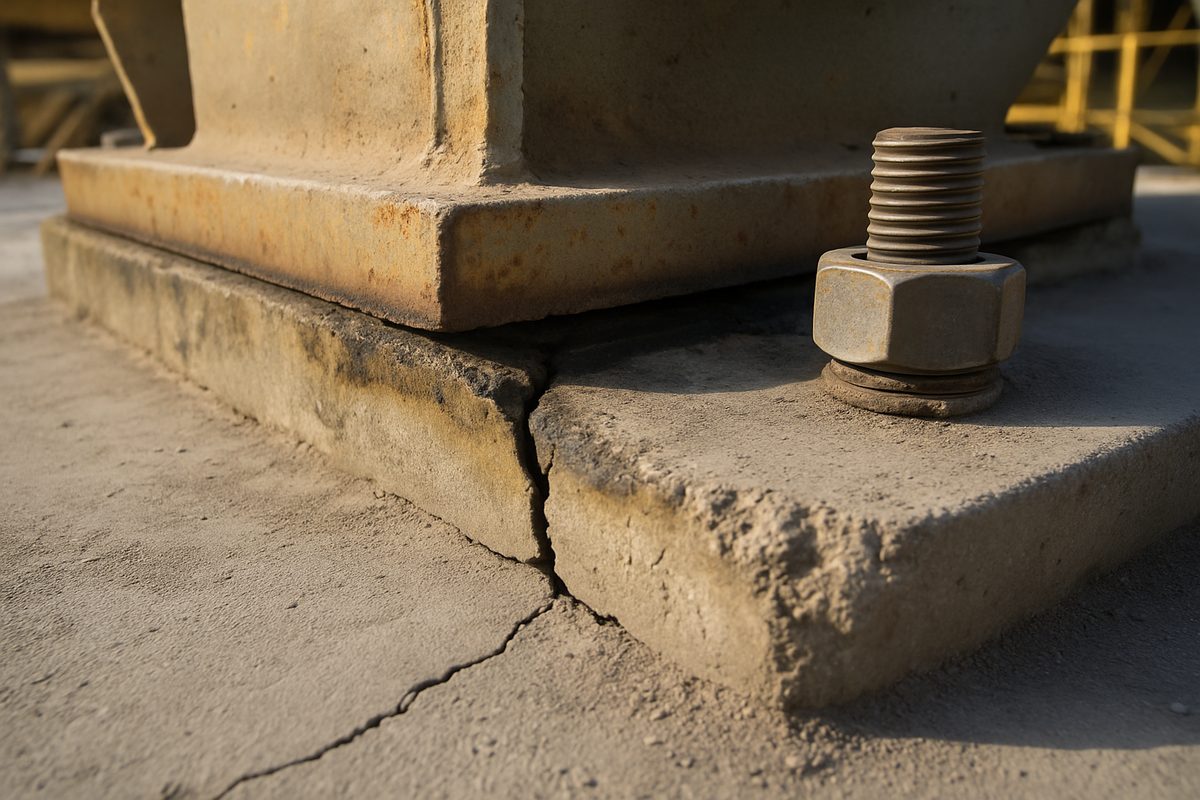 *Typical failure: a crack running from the baseplate corner and an oil-stained, spalled cementitious shoulder. Both point to regrouting, not patching.*
Two of these deserve extra emphasis because they are installation choices, not material defects.
Levelling method. Double nuts and metal shims are common because they are quick. But after grouting, the machine still bears mostly on the nut or shim, not on the grout. Jack (levelling) bolts are better. Wrap the bolt threads with petrolatum tape or rubber tubing so they do not bond, then back the bolts out once the grout has cured. The full load then sits on the grout. Anchor bolts. Fill anchor pockets in a separate step before the main pour, so air is not trapped. Where the design needs free bolt stretch, sleeve the bolt over its free length with foam insulation or petrolatum tape. Our anchor bolt embedment depth guide covers the embedment side of the calculation. For post-installed anchors in existing foundations, see epoxy anchor pull-out strength testing.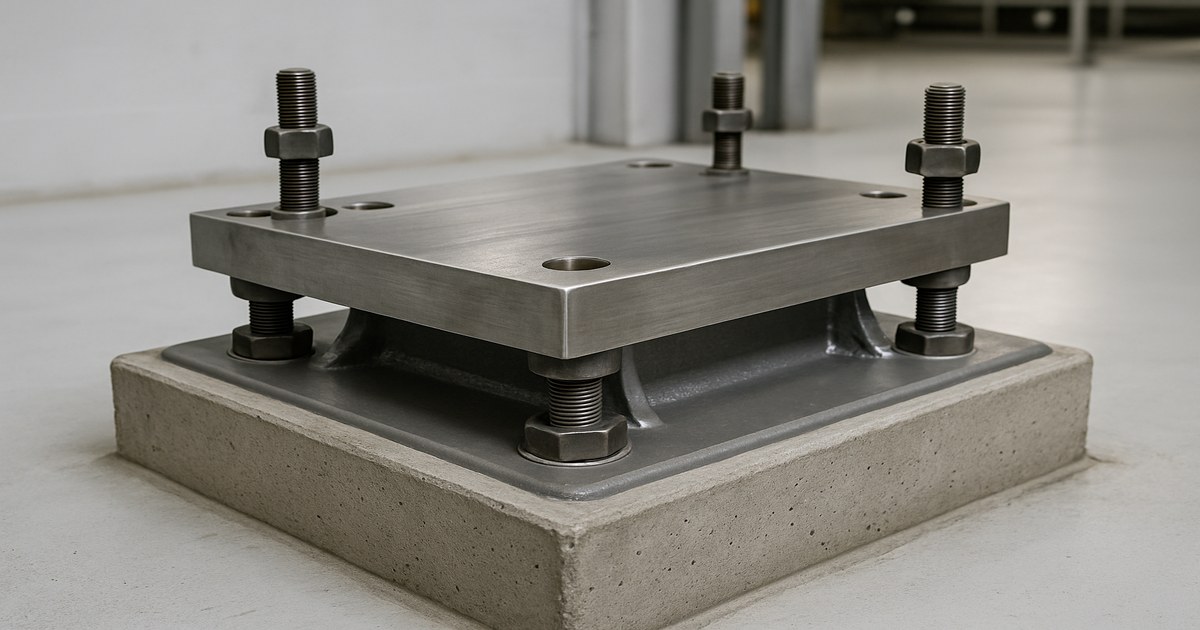 *Baseplate levelled on jack bolts before grouting. Once the grout has cured, the bolts are backed out so the grout carries the full load.*
Regrouting a SAG Mill or Crusher in One Shutdown
Most mining enquiries we receive are not for new installations. They are for foundation repair: an existing grout bed has cracked, the mill has gone out of alignment, or a crusher base has started moving. The aim is to finish the regrout inside a planned shutdown. A typical sequence:
| Step | Activity | Typical duration* |
|---|---|---|
| 1 | Isolate, support the equipment on jacks or cribbing, check alignment data | 2–6 h |
| 2 | Break out the old grout to sound concrete (chipping hammers, scabblers) | 6–16 h |
| 3 | Prepare the surface: remove laitance until ~50% clean aggregate shows; degrease steel | 2–6 h |
| 4 | Re-level on jack bolts, sleeve anchor bolts, build forms and header box | 4–8 h |
| 5 | Mix and pour epoxy grout from one side in a continuous pour | 1–4 h |
| 6 | Cure (epoxy, 20–25 °C) | ~24 h |
| 7 | Strip forms, back out jack bolts, torque anchors, check alignment | 2–6 h |
*\*Durations are indicative for a single mill or crusher base and depend on crew size and access. Confirm cure time against the product TDS and the actual grout temperature.*
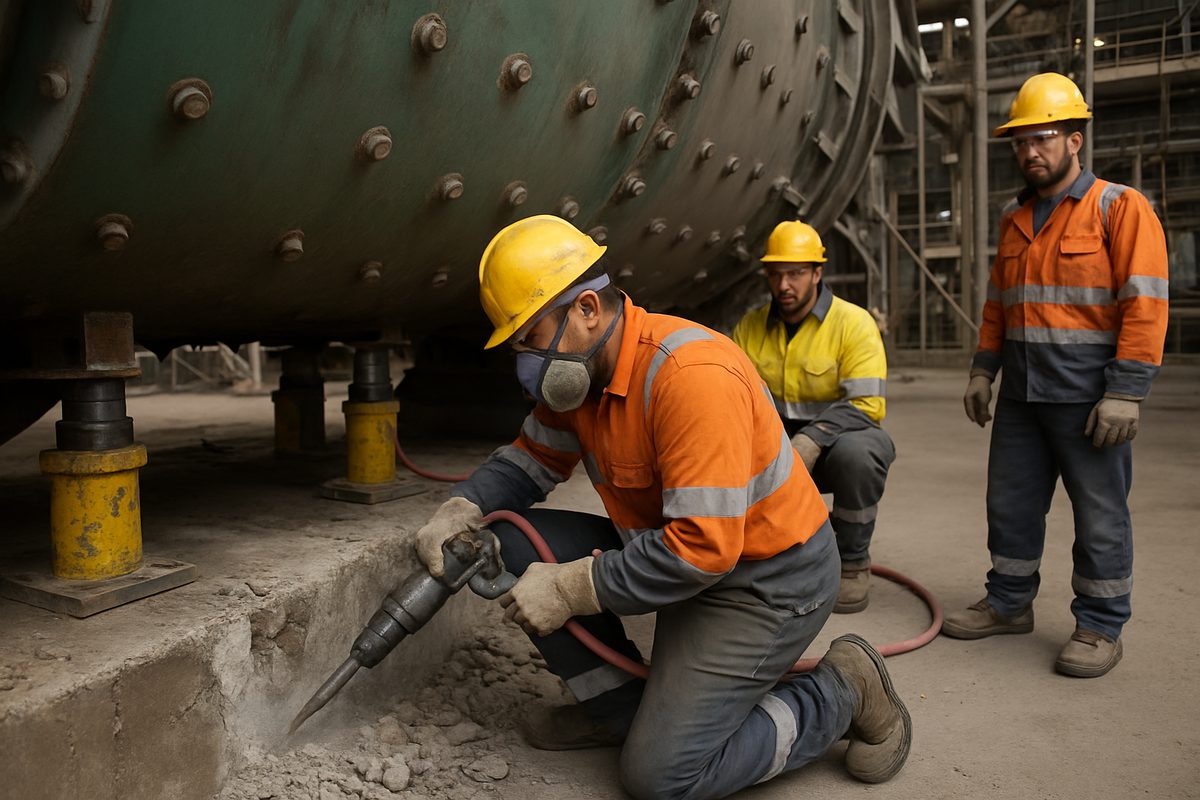 *Breaking out old grout to sound concrete is usually the longest step of a mill regrout. Plan crew size around it.*
Total: about 2–3 days with epoxy, against 5–9 days if a cementitious grout must reach strength before restart. For most concentrators, the lost throughput from those extra days costs far more than the full grout bill.
Cold sites. Epoxy cure slows sharply below about 10 °C. Store the kits in a heated container for at least 24 hours before use. Enclose and heat the work area, and keep it warm through the cure. Do not add solvent to "improve flow" in the cold. It permanently weakens the grout. Hot sites. Above about 30 °C, working time shortens. Pour early in the morning, shade the foundation, and stage kits so mixing never gets ahead of placement. Large epoxy pours also generate their own heat, so follow the maximum lift depth on the TDS.Two more rules apply to every regrout. Never use a vibrator on epoxy grout; rodding or strapping is enough with the right consistency. And never pre-soak concrete for epoxy. Pre-soaking is only for cementitious grout.
How to Calculate Grout Quantity
The formula is simple:
Volume (L) = length (m) × width (m) × average thickness (mm), then add 10–15% for shoulders, anchor pockets and waste. Weight (kg) = volume (L) × density. Epoxy machinery grout is about 2.0 kg/L. Cementitious grout is about 2.1 kg/L.Worked example: one mill soleplate of 3.0 m × 1.2 m with 50 mm average grout thickness.
| Item | Value |
|---|---|
| Net volume | 3.0 × 1.2 × 50 = 180 L |
| Plus 12% shoulders and waste | ≈ 202 L |
| Epoxy weight at 2.0 kg/L | ≈ 404 kg |
| 25 kg epoxy sets required | 17 sets (order 18–20 for spares) |
A mill with four soleplates of this size needs about 1.6 tonnes of epoxy grout. That is a typical size for a combined SAG and ball mill regrout order.
 *XQ-60 cementitious non-shrink grout, 25 kg bag. It is the economical choice for conveyor drives, columns and static structures on the same project.*
Pricing, MOQ and Logistics for Mine Sites
Indicative 2026 pricing for mining projects, FOB Ningbo:
| Item | Epoxy machinery grout | Cementitious non-shrink grout |
|---|---|---|
| FOB price | USD 3.20–5.60/kg | USD 0.35–0.70/kg |
| Approx. cost per litre placed | USD 6.40–11.20 | USD 0.75–1.50 |
| Packaging | 25 kg sets (resin + hardener + aggregate) | 25 kg bags; 1 t bulk bags on request |
| MOQ | 500 kg (20 sets) | 1,000 kg |
| Standard lead time | 12–18 days | 10–15 days |
| Shelf life | 12 months, sealed, 5–30 °C | 6 months, dry storage |
Logistics points that matter for mine sites in Chile, Peru, Australia, Africa and Central Asia:
- Dangerous goods. Epoxy hardener components are often classed as dangerous goods for sea freight (commonly Class 8, corrosive). We supply the SDS and DG-compliant packaging. Tell your freight forwarder early, because some routes have limited DG space.
- Temperature in transit. Containers can exceed 50 °C in summer transit. Ask for sealed kits and plan site storage at 10–30 °C.
- Consolidated orders. Many contractors order epoxy grout, cementitious grout and anchor adhesive in one container for the same shutdown. That keeps the mixed-product MOQ manageable.
What to Send for a Quote
To get an accurate quotation and material recommendation in one round, send:
You can browse our full grout material range, including the XQ-GZ epoxy grouting compound. For thinner, non-machinery repairs, also see our non-shrink grout selection guide.
Frequently Asked Questions
What is the best grout for a SAG mill foundation?
For SAG and ball mill soleplates, an aggregate-filled epoxy machinery grout is the usual choice. It has high compressive and tensile strength, excellent bearing contact, resistance to gear oil, and cures in about 24 hours. Always confirm the mill OEM's installation specification, because some OEMs set minimum grout properties.
Can cementitious grout be used under a crusher?
It can on some lighter or secondary crushers, but epoxy is generally preferred for jaw, cone and gyratory crushers. Impact and reversing loads crack cementitious grout at edges and corners, and oil contamination weakens it over time. Cementitious grout remains a good choice for conveyor drives and static structures.
How long before a mill can restart after epoxy regrouting?
At 20–25 °C, most epoxy machinery grouts reach load-bearing strength in about 24 hours. At lower temperatures the cure is slower, so heat the work area and check the product TDS. Cementitious grout typically needs 3–7 days before full operating loads.
How do I repair cracked grout under a mining machine?
Small cracks with sound bond can sometimes be pressure-injected with low-viscosity epoxy. If the grout has delaminated, is oil-soaked, or the equipment is moving, break out the old grout to sound concrete and regrout. See our concrete crack injection methods guide for the injection option.
How much epoxy grout do I need per soleplate?
Multiply length × width × average thickness, then add 10–15% for shoulders and waste. Multiply by about 2.0 kg/L. For example, a 3.0 m × 1.2 m soleplate with 50 mm grout needs about 400 kg, or 17 sets of 25 kg.
Do you supply epoxy grout to mines outside China?
Yes. We ship FOB Ningbo with full SDS, DG packaging and test reports. The MOQ is 500 kg for epoxy grout and 1,000 kg for cementitious grout, with 12–18 days standard lead time. Mixed containers with anchor adhesives and repair mortars are available.
Related Guides
- Epoxy Grout for Machinery Foundations: Baseplate Grouting Guide
- Pump Skid Grouting: API 686 Epoxy Grout
- Cementitious Grout vs Epoxy Grout
- Non-Shrink Grout: ASTM Properties & Equipment Base Selection
- Anchor Bolt Embedment Depth Guide
*Planning a mill or crusher regrout? Send your drawings and shutdown window to our engineering team for a grout recommendation, quantity take-off and FOB quotation within one working day. Request a Quote | View Grout Products | WhatsApp: +86 133 3618 3725*