
We manufacture anchoring adhesives, structural plate-bonding adhesives and CFRP systems. We get asked "is it certified?" on almost every enquiry, and the honest answer is more useful than a yes. This guide is what we send instead: what the approval systems actually test, what they deliberately leave out, what an approval costs a factory, and what to put in your purchase order when your supplier does not have one.
The Two Accidents That Wrote the Rulebook
Every sustained-load clause in every adhesive anchor standard traces back to two ceiling collapses.
Boston, 10 July 2006. Ceiling panels in the D Street portal of the I-90 connector tunnel fell and killed a motorist. The NTSB's probable cause was the use of an epoxy anchor adhesive with poor creep resistance in a sustained tensile-load application — a fast-set formulation that was never intended to hold a permanent dead load. Among the safety issues the NTSB listed was the absence, at the time, of any standard for testing adhesive anchors under sustained tension. Litigation settled at $458.2 million. ACI 355.4's own commentary now cites this collapse by name, together with the follow-up laboratory work (Ocel and Hartmann, 2007) that confirmed injection voids in the failed anchors. Sasago Tunnel, Japan, 2 December 2012, 08:03. Roughly 500 tonnes of ceiling panels and partition walls fell over a continuous 140 m section of the Chuo Expressway, killing nine people. The tunnel had been in service since 1977. Each CT steel beam was suspended by 16 adhesive anchor bolts. The MLIT investigation committee, reporting on 18 June 2013, found a chain of failures that is worth reading as a checklist:- The original design assumed a maximum pulling force of 12.2 kN per bolt. The committee's re-analysis, including ventilation and vehicle-induced wind effects that were never in the original calculation, put the real load at roughly 20 kN — about 8 kN per bolt unaccounted for.
- Of 182 anchors pull-tested after the collapse (138 selected at regular pitch, plus 44 more), 16 could not reach the 12.2 kN design service load, and 14 of those were in the largest cross-section where the ceiling was heaviest.
- Concrete cores taken at 56 bolt positions showed the bolt tip frequently did not reach the bottom of the hole. Spread adhesive, loose aggregate, hardener and the glass capsule tube itself were found sitting in the gap below the bolt tip. Voids in the tunnel lining let adhesive flow away from the bond zone entirely.
- Resin recovered from the bolts showed hydrolysis had already begun.
- Over 35 years the ventilation system had been switched on and off more than 200,000 times, superimposing load cycles on a permanent dead load.
- Hands-on and hammer inspection of the critical cross-section had not been performed for 12 years; inspections scheduled for 2008 and 2012 were both postponed.
So two jurisdictions looked at the same failure mode and went in opposite directions. The US and Europe wrote a creep test and kept the application. Japan restricted the application. If you are specifying an adhesive anchor in permanent tension today, that disagreement is the single most important thing to know, and almost no product datasheet mentions it.
Three Parallel Approval Systems — and What Each One Actually Is
"Certified" means three different things depending on which market your project sits in.
| United States | Europe | China | |
|---|---|---|---|
| Design code | ACI 318-19 Chapter 17 (was Appendix D in ACI 318-02/-11) | EN 1992-4 | GB 50367 / JGJ 145 |
| Qualification standard | ACI 355.4 (first printed 2011; current -19) | EAD 330499-00-0601 (July 2017) | JGJ 145 / GB 50728 test regimes |
| Acceptance criteria | ICC-ES AC308 (first printed 2006) | — (EAD is self-contained) | — |
| Document you receive | ICC-ES ESR (evaluation report) | ETA from a Technical Assessment Body, then CE marking | National/third-party test report (e.g. SGS, provincial institute) |
| Who tests | Independent testing and evaluation agency (ACI 355.4 Ch. 12) | Notified laboratory under the TAB | Accredited domestic lab |
| Recognised by | Building officials under the IBC | All EU member states | Chinese design institutes; accepted case-by-case elsewhere |
| Covers creep? | Yes — sustained load at standard and maximum long-term temperature | Yes — test series B14 and B15 | Varies by product scope |
A few points that cause real arguments on projects:
- An ESR or ETA is product-specific, not brand-specific. A manufacturer with an ETA on its 400 ml epoxy cartridge has no approval covering its bulk pail, its vinyl ester, or a different rod grade — unless those are named in the annexes.
- An ETA states which installation directions were assessed. EAD 330499 defines D1 (downward only), D2 (downward and horizontal) and D3 (downward, horizontal and upward/overhead). A product assessed to D1 is not approved overhead, even though it physically works.
- Neither document is a warranty. EAD 330499 is explicit that its 50-year figure is an assumed design working life for assessment purposes and "cannot be interpreted as a guarantee."
- A Chinese national test report is not an ESR or an ETA and will not satisfy a US building official on its own. It is, however, real test data — and under IBC Section 104.2.3 (alternative materials and methods), an authority having jurisdiction can accept it with engineering justification. That route exists; it is just slower and it puts the burden on the engineer of record.
What the Creep Test Actually Does to a Product
This is the test that separates a structural anchoring adhesive from a fast-set epoxy, and it is worth understanding in detail because it is also the test most often quietly skipped.
Under EAD 330499 clause 2.2.2.6, the European sustained-load series runs like this:
| Parameter | Requirement |
|---|---|
| Test type | Confined tension tests in uncracked C20/25 concrete |
| Anchor size | M12, or the smallest size offered if larger than M12 |
| Series B14 | Ambient, +21 °C ± 3 °C |
| Series B15 | At the declared maximum long-term temperature (not required for range T1) |
| Duration | Until displacements stabilise, minimum three months |
| Reading schedule | Every 10 min for the first hour → hourly for 6 h → daily for 10 days → every 5–10 days thereafter |
| Extrapolation | Findley power law: δ(t) = δ₀ + a·t^b, fitted to at least the last 20 days / 20 data points |
| Extrapolated to | 50 years (ambient) or 10 years (maximum long-term temperature) |
| Pass criterion | Extrapolated displacement < mean displacement at loss of adhesion (δu,adh) from the reference tests |
| After the test | Unload, then run a confined tension test; residual capacity compared against reference series R6 |
The American route reaches the same place by a different road. ACI 355.4 requires sensitivity-to-sustained-loading tests at standard and maximum long-term temperature (clause 7.17), and characteristic bond strength for design must correspond to a long-term temperature of 110 °F (43 °C). Then ACI 318 applies a second, blunter safety measure: for the portion of load that is sustained tension, the bond strength is multiplied by 0.55. That factor used to be 0.75 under the earlier ICC-ES AC308 regime — the reduction is a direct consequence of Boston.
Three things follow that buyers should know:
If you take one number from this article into your next specification: for permanent tension, design against the sustained-load value, not the catalogue pull-out value. Our epoxy anchor pull-out strength testing guide covers how to read and verify those numbers on site.
Exclusion 1: Adhesive the Installer Proportions Himself
This is the biggest and least-known exclusion, and it appears in both standards independently.
ACI 355.4 clause 1.2.3 states the standard does not address "bulk adhesives mixed in open containers without automatically controlled metering and mixing of adhesive components." EAD 330499, Note 2 states that only bonded fasteners in which "the mix proportions are controlled by the packaging of the bonding material" are covered, and that "systems where the mix proportions are controlled by the installer, such as the bulk type where component volumes have to be measured by the installer, are not covered."In practice:
| Format | In scope? |
|---|---|
| Glass capsule | Yes |
| Soft-skin capsule | Yes |
| Coaxial or side-by-side cartridge with static mixer | Yes |
| Foil pack with static mixer | Yes |
| Bulk with mechanical proportioning and mixing | Yes (with ongoing equipment monitoring) |
| Bulk supplied as matched A + B units, mixed exactly as supplied | Yes |
| Bulk where the installer scoops or measures A and B by eye or by bucket | No — cannot be qualified |
That last line matters commercially, because bulk A/B pails are cheaper per kilogram than cartridges and are extremely common on large anchoring and rebar-planting jobs. Our own bulk anchor adhesive is supplied as pre-matched A and B units for exactly this reason: once an installer is free to guess the ratio, no approval scheme in the world will cover the result. ACI 355.4's commentary adds that even legitimate bulk dispensing equipment requires ongoing monitoring of mix ratio, leak tightness and dwell time.

If you are buying bulk, put "pre-proportioned matched A/B units, ratio controlled by packaging" in the purchase order. It costs nothing and it is the difference between a qualifiable installation and an unqualifiable one.
Exclusion 2: Overhead and Horizontal Injection Without a Piston Plug
This one changed recently and almost nobody has caught up.
ACI 355.4-19's commentary to clause 1.2.3 states that injection of adhesive in the horizontal or upwardly inclined direction without the use of a piston plug or similar back-pressure device to avoid air voids "is no longer included in the scope of this Standard."
The reasoning is the Boston chain of evidence. NTSB documented improper installation based on the failed anchors and their neighbours; laboratory work (Silva, 2016) then showed that injecting with only an extension tube — no back-pressure device — does not produce a reliable installation, while a piston plug consistently does. For small holes of 1/4 in. to 3/8 in., an extension tube whose diameter equals the hole diameter achieves the same effect.
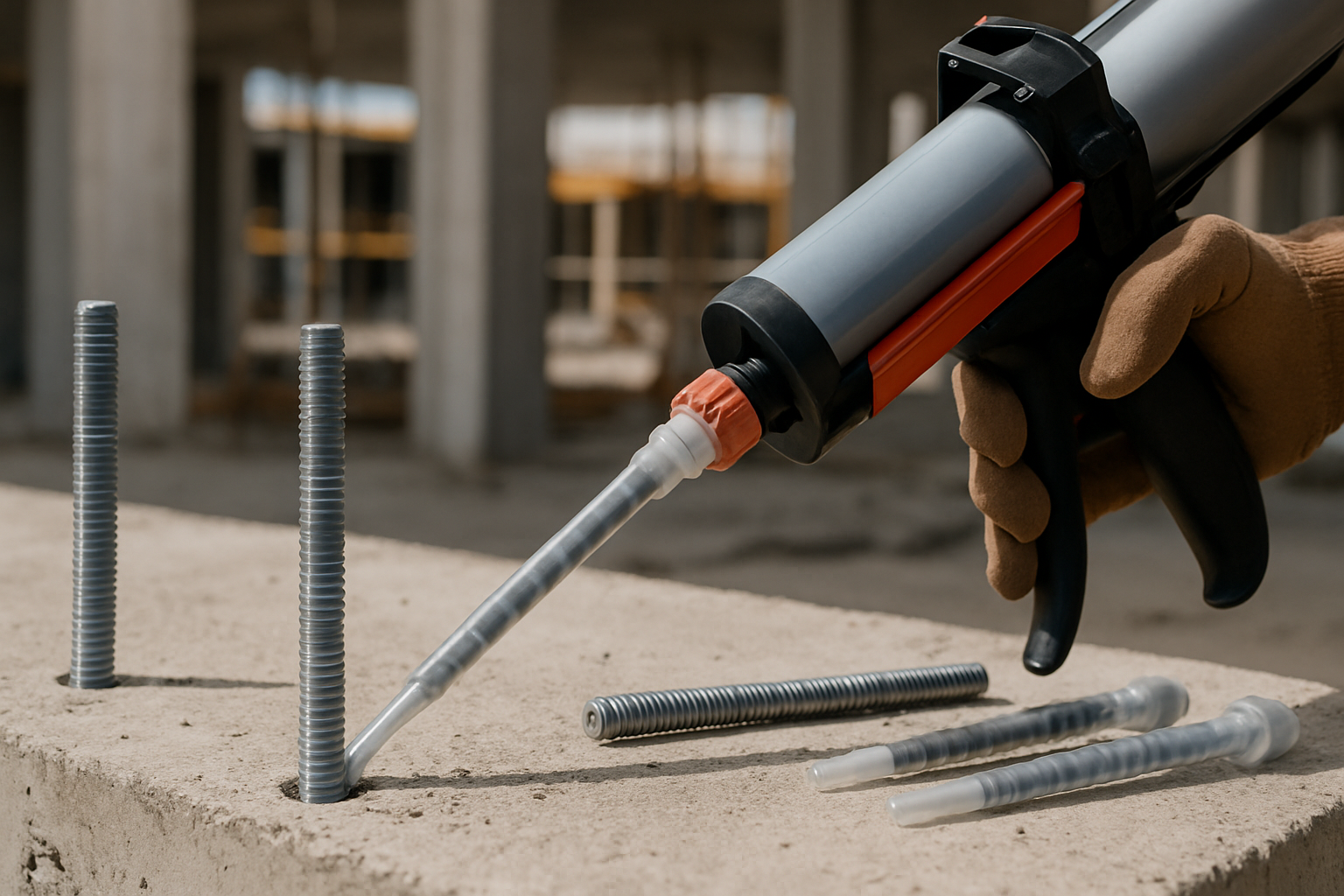
So: a horizontally or overhead-injected anchor, installed with a plain extension tube, is outside the current US qualification standard regardless of which adhesive was used. Europe handles the same risk through the D1/D2/D3 installation-direction categories and a separate installation-safety test series.
The practical consequences for a buyer:
- Ask whether the piston plugs for your hole diameters are available and included. Most cartridge systems sold into export markets ship without them.
- Budget for them. They are consumable and installers lose them.
- If your project has overhead sustained tension — pipe supports, suspended ceilings, cable trays under a slab — this is the single highest-risk detail on the job, and the ACI/CRSI Adhesive Anchor Installation Certification exam tests it directly, including a blind overhead installation into inverted test tubes graded for voids. ACI 318-19 Section 26.7 requires certified installers for these conditions; California's 2022 CBC goes further and requires certification for all horizontal and overhead adhesive anchors in hospitals and schools, regardless of load direction.
Exclusion 3: Bonded Plates and External CFRP Are Not Adhesive Anchors
ACI 355.4 clause 1.2.3 excludes "adhesives to adhere structural elements to concrete surfaces outside of a drilled hole," and its commentary names the examples directly: bonded steel plates and external carbon fibre reinforcement. It adds, correctly, that "other standards exist for these purposes."
This causes genuine confusion on tenders, because the chemistry is often similar and the same factory makes both. But the qualification routes are completely separate:
| Application | Qualification route |
|---|---|
| Threaded rod or rebar bonded into a drilled hole | ACI 355.4 / EAD 330499 → ESR / ETA |
| Steel plate bonded to a concrete face | ASTM C881, EN 1504-4, GB 50728 |
| External CFRP fabric or plate bonding | ACI 440.2R, EN 1504-4, ASTM D7522 (pull-off), GB 50367 |
| Segmental bridge joint adhesive | ASTM C881 Type VI, EN 1504-4 |
So if a supplier offers you an "ETA-approved structural adhesive" for plate bonding or CFRP, the claim is category-confused: EAD 330499 does not cover that application at all. What you should be asking for instead is EN 1504-4 or ASTM C881 classification plus pull-off test data to ASTM D7522 or the equivalent in your code. Our structural adhesive for concrete bonding and two-part adhesives comparison guides set out which standard applies to which product family.
Exclusion 4: Underwater Installation
EAD 330499 defines two concrete conditions: I1 (installation in dry or water-saturated concrete) and I2 (installation in water-filled drill holes, sea water excluded). Note 7 then draws a hard line:
> Water-filled holes are pre-drilled holes which are afterwards filled with water (e.g. overnight rain in outdoor applications). Underwater installation is different to this condition as the water pressure has to be accounted for and are therefore not covered in this EAD.
A flooded hole after rain is assessed. A hole drilled by a diver at 6 m depth is not — and neither is sea water at any depth. This has nothing to do with whether the adhesive works underwater; several do. It means there is no European route to an ETA for that use case, so any underwater anchoring must be justified by project-specific testing.
We supply underwater epoxy grout and FRP jacketing systems for pile and pier repair, and we say the same thing to every enquiry: expect to fund a job-specific trial and proof-load programme, because no type approval will carry you. Our underwater concrete repair guide covers what that trial should measure.
Exclusion 5: Fatigue and Impact Loads
EAD 330499 Note 12: fasteners subject to impact loads (for example fall-arrest device attachments) and/or fatigue loads are not covered.
ACI 355.4 clause 1.2.3 item 4: the standard does not address adhesive anchors resisting fatigue or shock loading, because the range of possible loading conditions is too wide. Its commentary notes that fatigue and shock may reduce bond, steel and concrete strength, that these effects are not addressed, and that fatigue is generally more of a problem for the anchor element than for the adhesive — with preload used to reduce stress fluctuation in the rod, which only works if enough unbonded length is provided for elastic stretch.
Where this bites in practice: crane rails, machine bases, reciprocating compressors, vibrating screens, fall-arrest anchors, and — as Sasago showed — anything under a ventilation system that cycles 200,000 times. An ESR or ETA number on the datasheet says nothing about any of these. Ask for cyclic test data specifically, and specify preload.
Exclusion 6: The Geometry and Substrate Fine Print
Both standards define a narrow window. Step outside it and the approval simply does not apply, even if the product is genuinely approved.
| Parameter | EAD 330499 | ACI 355.4 |
|---|---|---|
| Hole orientation | Perpendicular to surface, max 5° deviation | — (direction assessed separately) |
| Minimum anchor size | M6 | da ≥ 1/4 in. |
| Hole diameter | — | d₀ ≤ 1.5 da |
| Minimum embedment | ≥ 40 mm and ≥ 4d | ≥ 4da, or 1-5/8 in. |
| Maximum embedment | ≤ 20d (per EN 1992-4) | ≤ 20da |
| Member thickness | h ≥ hef + Δh, h ≥ 100 mm, Δh ≥ 2d₀ and ≥ 30 mm | Assessed by test |
| Concrete age at installation | ≥ 21 days | ≥ 21 days (raised from 7) |
| Installation/cure temperature | 0 °C to +40 °C | Declared and tested |
| Screeds, non-structural toppings | Not covered (Note 11) | Not covered |
The 21-day rule catches more projects than any other line in that table. On a fast-track programme, anchoring into 10-day-old concrete is outside both standards — and outside your supplier's liability, whatever the datasheet says. The 20d embedment ceiling catches the second-most: beyond 20 diameters you can no longer assume bond stress is uniform along the embedment, which is why deep post-installed rebar connections are designed with development-and-splice theory instead of anchor theory. See our anchor bolt embedment depth guide for the calculation limits.
What an Approval Costs a Factory — and Why Most Don't Have One
Nobody in this industry publishes these numbers, so here they are from a Technical Assessment Body's own published tariff.
| Item | Cost (EUR) |
|---|---|
| ETA where an adopted EAD exists (the bonded-fastener case), by file complexity | 6,775 – 10,980 |
| ETA where an EAD must be developed first | 10,980 – 17,270 |
| Converting a legacy European Technical Approval into an ETA | 2,105 – 5,785 |
| Duplicate ETA | 2,105 |
| Appeal | 5,000 |
Two caveats that change the picture completely:
On the American side, the timeline is the binding constraint: a full ICC-ES programme commonly takes 18 to 24 months from test-plan approval to publication, plus annual renewal fees and quality-control inspections of the plant. (ICC-ES has frozen ESR renewal pricing through 31 December 2026 and added a 7% discount on two-year renewals.)
That is the real reason most Chinese and Indian anchor adhesive manufacturers hold national test reports rather than an ESR or ETA. It is not a formulation gap — the chemistry is mature and widely available. It is a six-figure, two-year, per-SKU certification gap. Anyone who tells you otherwise is selling you something. Our guide to selecting a structural adhesive manufacturer covers how to audit the rest of a supplier's documentation.
What to Demand When Your Supplier Has No ESR or ETA
If the project genuinely requires an approved anchor — a US building official, a European CE-marking requirement, a nuclear or rail client — then buy an approved anchor. No amount of test data substitutes for the document.
For everything else, here is the package that a serious factory can produce and a trading company cannot:
| Document | What it proves | Red flag |
|---|---|---|
| ISO 9001 certificate with adhesives named in the scope | The QMS actually covers this product | Scope says "trading" or lists unrelated products |
| Batch certificate of analysis | Tensile, lap shear, compressive strength, glass transition temperature (Tg) for this lot | No Tg — you cannot assess elevated-temperature behaviour |
| Bond strength test report by hole condition | Dry, wet and flooded-hole values tested separately | A single bond strength with no hole condition stated |
| Sustained-load / creep data | Test duration, temperature, load level, extrapolation | "Excellent creep resistance" with no test behind it |
| Declared temperature range | Maximum long-term and short-term service temperature | One number, or only a cure temperature |
| Installation direction tested | Downward / horizontal / overhead | Silence — assume downward only |
| Mix ratio control | Pre-proportioned packaging or metered equipment | "Mix approximately 3:1 by eye" |
| Shelf life with A and B dated separately | Real remaining life on arrival | Single date on the carton |
| MPII (manufacturer's printed installation instructions) | Hole cleaning sequence, cure schedule, piston plug requirement | A one-page flyer |
Then design as if the anchor is Category 3, not Category 1. ACI 355.4 assigns anchor categories from reliability test results, with descending strength reduction factors — published calibration work proposes φ of about 0.65 / 0.60 / 0.55 for categories 1 / 2 / 3 in tension, and as low as 0.45 for low-reliability adhesives. If you do not have qualification data telling you which category your product is in, assume the worst one. That is a design decision that costs a little steel and removes most of the risk.
Finally, proof-load on site. Sample tension testing to a defined proof load is the only evidence that the anchors in *your* concrete, cleaned by *your* crew, actually work.
Why Hammer Testing Would Not Have Caught Sasago
One last finding from the Japanese investigation deserves to be a standing rule.
After the collapse, three inspectors were asked to assess the anchors by hammer sounding before the pull-out tests were run. The committee then compared their assessments against the measured strengths and concluded that hammering has real technical limits — in particular, the difficulty of estimating pull-out strength from the sound.
Which is to say: the standard, cheap, non-destructive field QC method used across the industry did not reliably identify the anchors that could not carry their design load. The defects at Sasago were inside the hole — bolt tips short of the bottom, capsule debris in the bond zone, adhesive lost into lining voids. None of those change how a bolt head sounds.
The implications are uncomfortable but simple: hammer sounding is a screening tool for gross defects, not a strength test. Where anchors carry sustained tension, specify sample proof loading, specify continuous special inspection during installation (which under ACI 355.4's quality-control provisions can also earn a higher anchor category and a better φ factor), and photograph hole cleaning. Inspection after the fact cannot recover information that was destroyed when the hole was filled.
Frequently Asked Questions
Does a chemical anchor have to have an ICC-ES ESR or ETA to be used on a project?
It depends on the jurisdiction and the application. Under the IBC, an anchor without an evaluation report falls under Section 104.2.3 (alternative materials and methods) and needs the building official's acceptance, supported by engineering justification and test data. In the EU, CE marking of a bonded fastener requires an ETA under EAD 330499. For private industrial work in many markets, a national test report plus project proof-load testing is routinely accepted. Ask your engineer of record before you buy, not after.
What is the difference between an ETA and an ICC-ES ESR?
An ETA is issued by a European Technical Assessment Body under EAD 330499-00-0601 and leads to CE marking valid across EU member states, with design to EN 1992-4. An ESR is issued by ICC Evaluation Service against acceptance criteria AC308, which is harmonised with ACI 355.4, and supports design to ACI 318 Chapter 17 for US building officials. They test broadly the same phenomena but are not interchangeable documents, and a product may hold one and not the other.
Why is the sustained-load factor 0.55?
ACI 318 multiplies characteristic bond strength by 0.55 for the sustained tension portion of the load. The factor was 0.75 under the earlier ICC-ES AC308 regime and was reduced after the 2006 Boston tunnel ceiling collapse, in which an adhesive with poor creep resistance was used in permanent tension. It sits on top of — not instead of — the creep testing required during qualification.
Can bulk A/B anchoring adhesive ever be code-compliant?
Yes, but only if the mix proportions are controlled by the packaging or by automatically metering equipment. Both ACI 355.4 (clause 1.2.3) and EAD 330499 (Note 2) explicitly exclude bulk systems where the installer measures the component volumes. Specify pre-proportioned matched A and B units, and if you use dispensing equipment, specify ongoing monitoring of mix ratio, leak tightness and dwell time.
Is an ETA-approved structural adhesive suitable for bonding CFRP plates?
No — the question is category-confused. EAD 330499 covers bonded fasteners in drilled holes. ACI 355.4 explicitly excludes adhesives used to bond structural elements to a concrete surface outside a drilled hole, naming bonded steel plates and external carbon fibre reinforcement, and notes that other standards apply. For plate and CFRP bonding, ask for EN 1504-4 or ASTM C881 classification and ASTM D7522 pull-off data instead.
My project anchors into concrete that is only 12 days old. Is that a problem?
It is outside both qualification standards, which assume hardened concrete at least 21 days old at installation. The concrete will still be gaining strength and its moisture state differs from the tested condition. Either wait, or treat it as a project-specific case with job trials and proof loading, and get the engineer of record's written acceptance.
What does a chemical anchor cartridge cost from a Chinese factory, and what is the MOQ?
Current indicative FOB bands are roughly USD 3.50–5.00 for a 390 ml vinyl ester cartridge and USD 5.50–7.50 for a 585 ml epoxy cartridge, with MOQ typically from 500 cartridges and lead times of 4–6 weeks depending on size and packaging. Bulk pre-proportioned A/B units are cheaper per kilogram. Prices exclude piston plugs and static mixers, which should be quoted as a separate line — see the piston plug section above for why that line matters.
Specify It Properly, and We Will Tell You the Truth About It
We formulate and fill anchoring adhesives, plate-bonding adhesives, crack injection resins and CFRP systems, and we test them to the Chinese national system — GB 50367, GB 50728, JGJ 145 and GB/T 50448 — under an ISO 9001 quality system, with third-party verification reports available per batch.
What we will not do is tell you that a national test report is an ETA. If your project needs an approved anchor, we will say so. If it does not, we will send you the batch data, the hole-condition test results, the declared temperature range and the installation instructions, and help you build the alternative-means package your engineer needs.
Request a quote and a full document pack → — send the specification clause, the load case (sustained or not), the installation direction, the hole condition and the service temperature, and you will get a straight answer within 12 hours.
Related Guides
- Chemical Anchor Systems: Complete Technical Guide
- Epoxy Anchor Pull-Out Strength: Testing Methods and Design Values
- Chemical Anchor Installation: Step-by-Step
- Adhesive Anchor vs Mechanical Anchor: Load Capacity and Selection
- Vinyl Ester vs Epoxy Chemical Anchor
- Anchor Bolt Embedment Depth: ACI 318 Calculation Tables
- Epoxy Anchor Manufacturer in China: Factory-Direct Buying Guide